
For this guide, 1:500 means 1 part concentrate to 500 parts water. That gives 501 parts total. Whether you start with 2L of water or want 2L including the concentrate determines which calculation to use.
These are volume-based arithmetic examples. Check that the product instructions use this same concentrate-to-water convention before applying them; 1 part concentrate in 500 parts total is a different instruction.
Example 1: 2L total, including concentrate
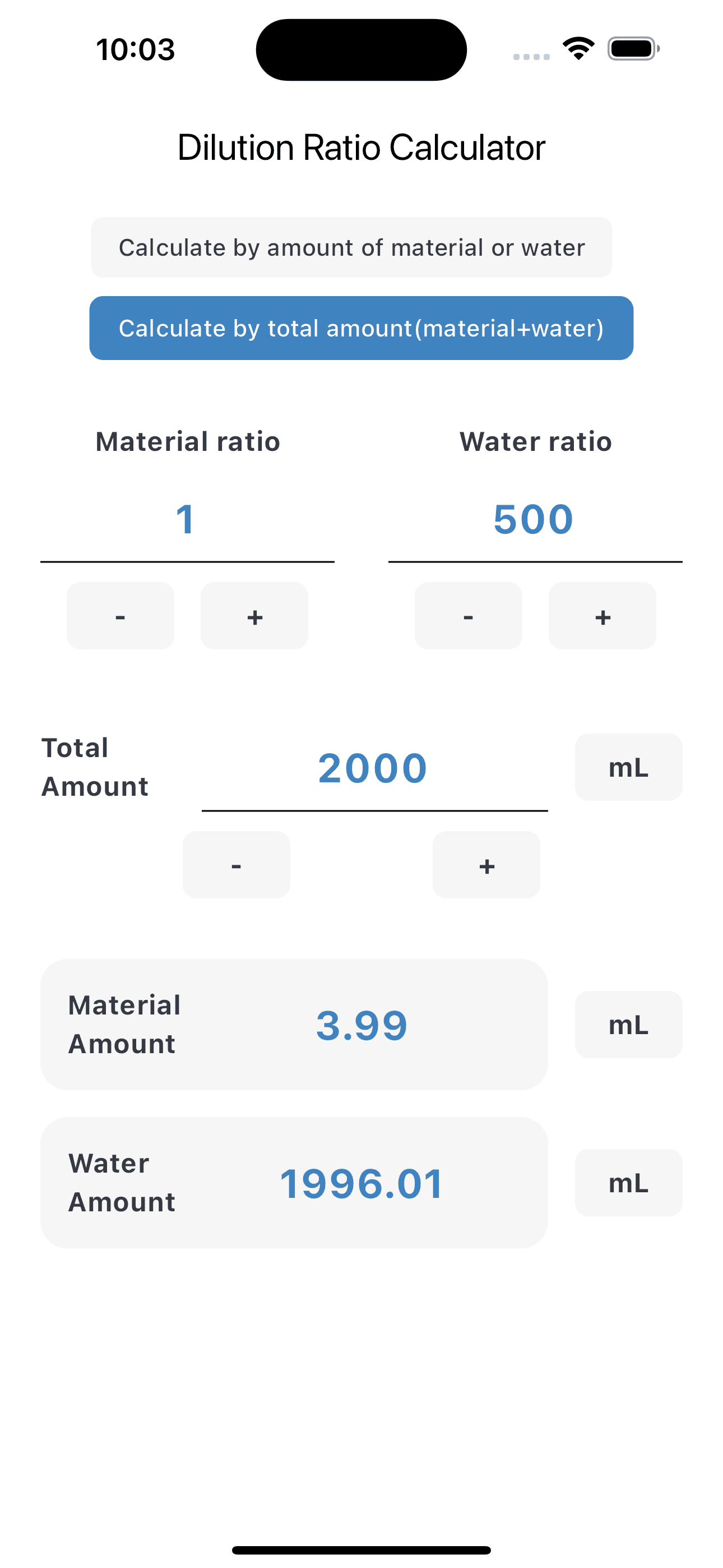
For a total of 2,000 mL, divide it into 501 parts:
- Concentrate = 2,000 × 1 ÷ 501 ≈ 3.992016 mL
- Water = 2,000 × 500 ÷ 501 ≈ 1,996.007984 mL
Rounded to two decimal places, the results are 3.99 mL concentrate and 1,996.01 mL water. Rounding to whole mL gives about 4 mL and 1,996 mL, but those rounded amounts are not the exact ratio. The measuring precision required for use comes from the product instructions.
In the app, choose total amount, enter concentrate ratio 1, water ratio 500, and total amount 2,000 mL.
Example 2: adding concentrate to 2L of water
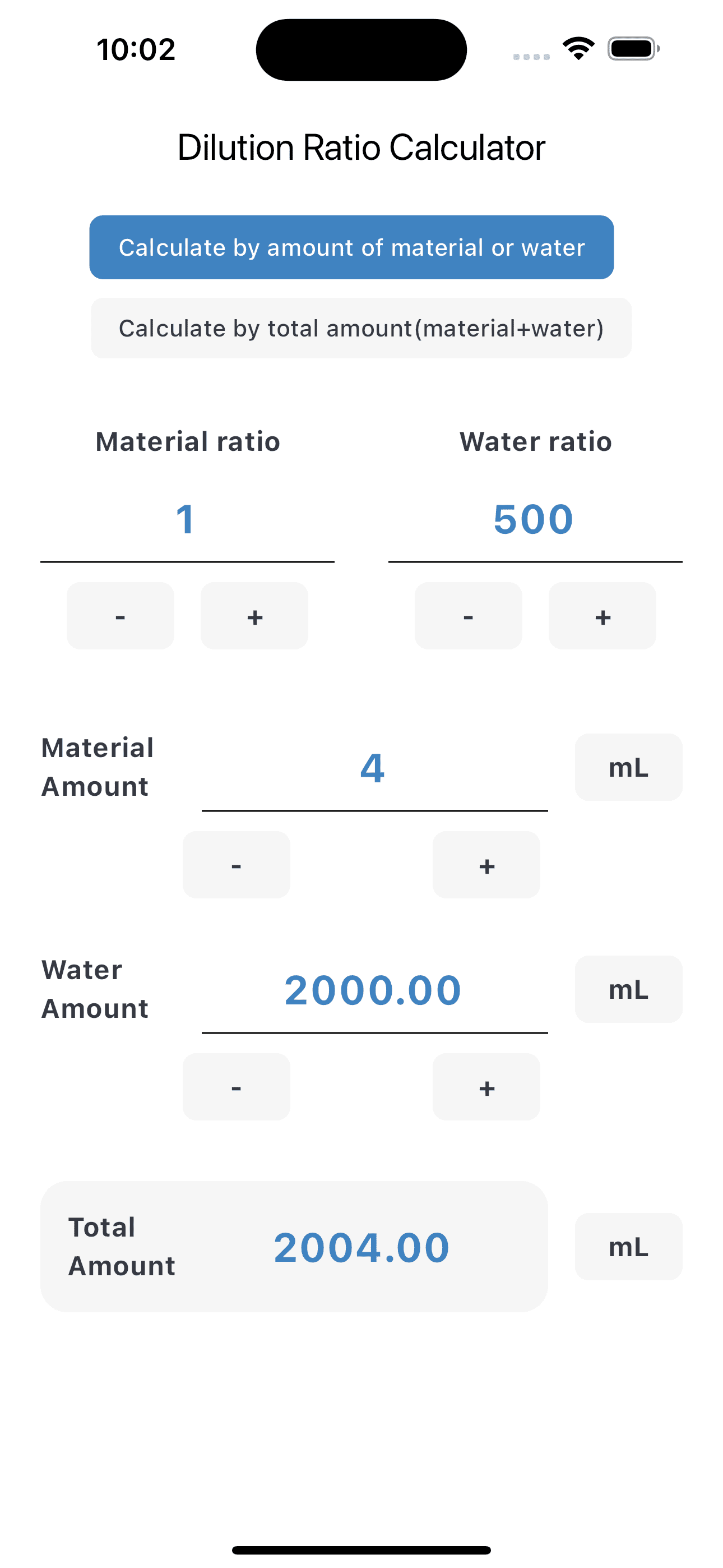
If the water alone is 2,000 mL, calculate the concentrate from that amount:
- Concentrate = 2,000 × 1 ÷ 500 = 4 mL
- Calculated total = 2,000 + 4 = 2,004 mL
Choose material/water amount in the app, enter the same 1:500 ratio and water amount 2,000 mL. The result is 4 mL concentrate. Entering 4 mL concentrate instead gives the same 2,000 mL water result.
Compare the two inputs
| What the 2L refers to | Concentrate | Water | Calculated total |
|---|---|---|---|
| Total of concentrate and water | ≈ 3.99 mL | ≈ 1,996.01 mL | 2,000 mL |
| Water before adding concentrate | 4 mL | 2,000 mL | 2,004 mL |
The first row is rounded to two decimal places. The small difference does not make the two inputs interchangeable. These formulas assume measured volumes are additive; follow a product's specific final-volume method where required.
What if the label means 1 part in 500 total?
Then the concentrate-to-water ratio is 1:499. A 2,000 mL total contains 4 mL concentrate and 1,996 mL water under the additive-volume calculation. Use 1 and 499 in the app's ratio fields. More on concentrate, water and total-volume conventions
Measuring and choosing a container
Use equipment appropriate to the product and small quantities being measured. Follow the label for the actual dose, mixing order and protective equipment. EPA product-label guidance
Do not use a drinking-water bottle for pesticides. Keep pesticide stocks in their labeled original containers and follow the product instructions for a suitable mixing container; beverage containers can be mistaken for something to drink. EPA safe-storage guidance
Do not mix household bleach with other cleaners or disinfectants. CDC bleach guidance
Use the dilution calculator
The Dilution Ratio Calculator calculates amounts from a ratio you enter. It does not determine whether 1:500 is appropriate for your product. Check the ratio basis, calculation mode and units before using the displayed result.