
Dilution questions often concern the ratio basis, finished volume and product instructions. Here is how to separate them in the calculator.
1. Is '1000-fold dilution' the same as concentrate:water 1:1000?
Check what the instruction compares. Concentrate:water 1:1000 totals 1001 parts. Concentrate:total 1:1000 totals 1000 parts. These are different definitions, not an everyday-versus-accurate distinction.
For 1000 mL total, concentrate:water gives about 0.999 mL concentrate and 999.001 mL water. Concentrate:total gives 1 mL concentrate, with 999 mL water under the additive-volume calculation. Use an explicitly stated product dose when available.
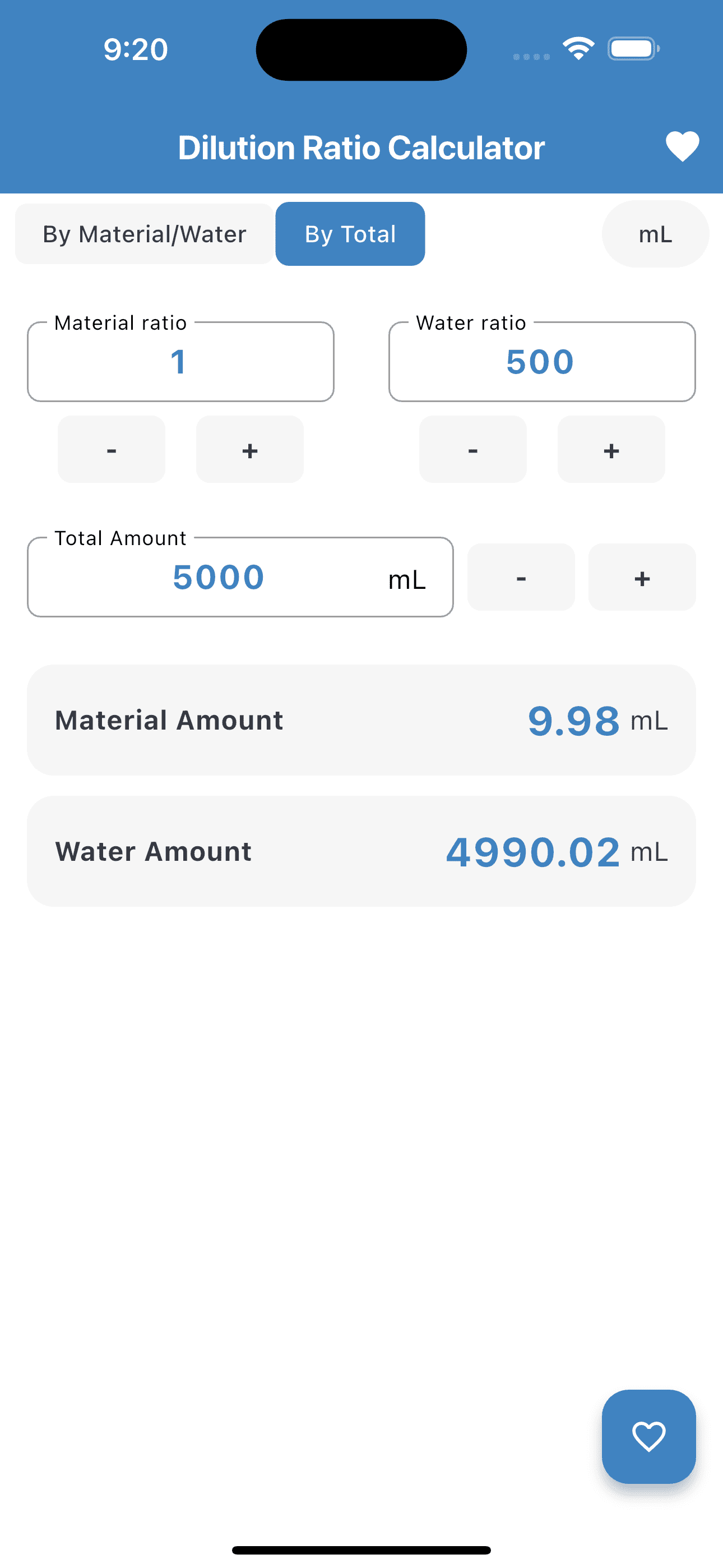
2. How much concentrate makes 5L total at concentrate:water 1:500?
5L = 5000 mL, divided into 501 parts:
- Concentrate: 5000 ÷ 501 ≈ 9.98 mL
- Water: 5000 × 500 ÷ 501 ≈ 4990.02 mL
Enter concentrate 1, water 500, By Total, 5000 mL. Starting with 5000 mL water instead uses By Material/Water: 10 mL concentrate, 5010 mL total.
3. Which goes in first: concentrate or water?
The calculator does not determine mixing order. Follow the product instructions. CDC bleach guidance says to follow the label and avoid mixing bleach with other cleaners or disinfectants. That does not establish one mixing order for every chemical product.
See Dilution Ratio Calculator instructions for the input modes. Check the product instructions for its ratio and method. Product label guidance